
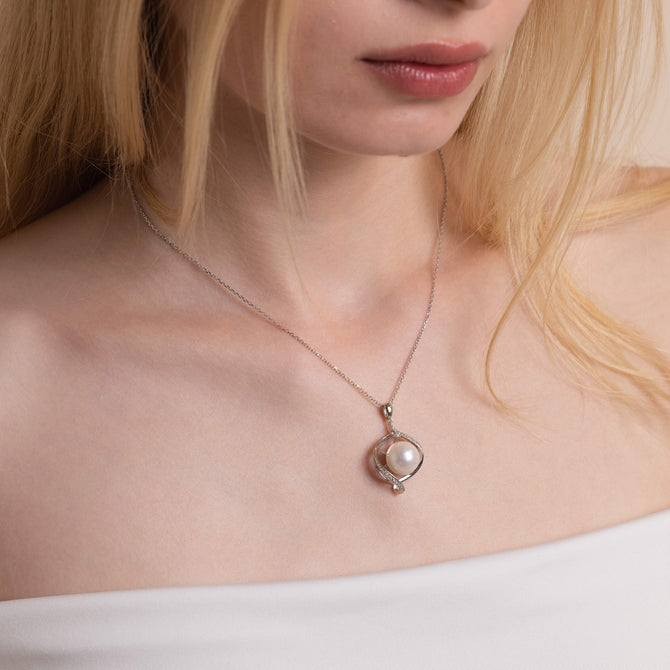

For over 4,000 years, natural pearls have been cherished as Earth’s most luminous treasures — born not from mines, but from the mysterious depths of the ocean. Unlike other gemstones that require cutting or polishing, pearls emerge perfect, formed through nature’s quiet alchemy within living oysters. Their story is deeply interwoven with human culture, trade, and desire — from ancient empires to royal courts and modern collectors.
Origins: The Persian Gulf — Cradle of Natural Pearls
The Persian Gulf stands as the birthplace of the pearl trade, with evidence of organized pearling dating back to 2000 B.C. Its fertile waters, nourished by the Tigris and Euphrates, nurtured the Pinctada Radiata, an oyster species renowned for producing radiant pearls.

”Pearl Harvest Boat in Persian Gulf“
Archival photographs from the early 1900s capture rows of wooden dhows anchored beneath the desert sun, their decks crowded with divers preparing for months at sea. A typical crew lived aboard these boats for up to 120 days, diving from dawn until dusk. With nothing but a nose clip, finger guards, and a stone weight, each diver plunged 10–20 meters below the surface, retrieving oysters by hand before being hauled up by rope. Many repeated the dive 60 times a day, sustained only by simple rations and the rhythmic chants of the nahham, the ship’s singer.
By the 1920s, the Gulf employed over 20,000 divers, fueling a booming global industry. Yet, this prosperity was fleeting. Harsh conditions, overfishing, and the arrival of cultured pearls in the 1930s led to its collapse — marking the end of a golden era.
The Spread of the Pearl: From Sri Lanka to the Americas
Ceylon (Sri Lanka) — The Roman Empire’s Pearl Source
From 550 B.C. onward, the Gulf of Mannar between India and Sri Lanka thrived as one of the world’s most abundant pearl fisheries. Ancient records describe how Roman merchants sailed across the Indian Ocean to acquire these prized “Oriental pearls,” famed for their smooth surfaces and warm iridescence. The island’s fishers were celebrated for their unmatched skill and courage, diving for minutes under the tropical sun to harvest nature’s hidden gems.

”Pearl Divers in Ceylon“
Over centuries, environmental shifts and overharvesting brought this luminous era to an end, leaving only legends of the great pearl fleets that once filled the Mannar waters. Nowadays, Sri Lanka is renowned not for its pearls but for its abundant treasures of another kind — sapphires, rubies, and other rare gemstones that continue its heritage as an island of brilliance.
The Americas — From Mayan Ruins to Colonial Treasures
Archaeological finds from Mayan and Peruvian ruins show that pearls were treasured long before Columbus. During Spanish colonization, American pearl fisheries flourished — notably in Panama and Venezuela — producing exquisite black and pink pearls. Yet overharvesting quickly exhausted these natural reserves.
By the 19th century, American freshwater mussels sparked a brief pearl rush, with discoveries in rivers like the Mississippi. But industrial pollution soon pushed these ecosystems to near extinction.
Europe’s Lustrous Legacy
In Europe, the story of pearls unfolded not in the sea but within the rivers and lakes of the North — where freshwater mussels quietly produced gems of subtle, silvery glow. From the misty highlands of Scotland to the forested rivers of Russia and Bavaria, these pearls became symbols of purity, nobility, and divine favor, deeply woven into the continent’s aristocratic and spiritual traditions.
Scotland — The White Treasures of the Tay and Spey
Scotland’s rivers Tay, Spey, and Dee were once famous for their brilliant white pearls, celebrated for their natural luster and flawless roundness. These “Scotch pearls” adorned royal crowns and ceremonial jewelry, including pieces worn by Mary, Queen of Scots, and later by Queen Victoria, who personally collected Scottish pearls during her stays at Balmoral.

”Crown of Scotland“
Russia — Pearls of Faith and Empire
In medieval Russia, river pearls drawn from the northern lakes of Arkhangelsk, Kola, and the Volga basin held spiritual and imperial significance. They were sewn into religious icons, clerical robes, and tsarist regalia, symbolizing divine wisdom and eternal life. By the 17th century, the Russian Orthodox Church was one of the largest consumers of pearls in Europe, and Russian nobles commissioned entire gowns embroidered with thousands of natural pearls, each representing purity before God.
Germany and Central Europe — The Bavarian Connection
Further west, the rivers of Bavaria and Saxony yielded their own treasures. Bavarian pearls, known for their warm cream tones, entered the luxury markets of Paris and London as early as the 14th century, traded alongside fine textiles and gold filigree. They became fashionable adornments in Renaissance courts and were frequently used in brooches, rosaries, and bridal jewelry across the Germanic states.
The Decline of Europe’s Natural Pearl Fisheries
By the late 19th century, the Industrial Revolution brought sweeping ecological change. Factory pollution, river engineering, and overfishing destroyed vast mussel habitats across the continent. Once-productive rivers turned murky and lifeless, and by the early 20th century, natural pearl harvesting had almost disappeared from Europe.
Today, only a few protected rivers in Scotland and Ireland still harbor remnants of these ancient mussel populations. Their preservation stands as a quiet tribute to Europe’s lustrous legacy — an age when pearls were not only ornaments of beauty, but living symbols of purity, craftsmanship, and devotion.

”Natural Pearl harvested in Europe“
China — The Ancient Artisans of the Pearl
China’s relationship with pearls is as old as its civilization. References in The Book of Documents (2200 B.C.) record pearls given as tributes to emperors — symbols of purity, virtue, and heavenly favor.
During the Zhou and Han dynasties, pearls were revered not for their size or value but for their moral beauty. The Chinese believed that pearls carried the wisdom of water and the light of the moon.
Japan — From Myth to Modern Mastery
The story of Japan’s pearls begins not in commerce, but in myth and devotion. Ancient chronicles such as the Kojiki (712 A.D.) and Nihon Shoki recount pearls as heavenly “white balls” (Shira-tama), gifts from sea deities offered to emperors and sacred shrines. These luminous orbs were believed to embody purity and the spirit of the ocean — “drops of the moon fallen into the sea.”
For nearly two thousand years along Japan’s coast, an extraordinary tradition known as Ama — literally “women of the sea” (海女) — has seen female free-divers plunging into chilly surf without scuba gear to harvest abalone, oysters, pearls and seaweed. Donning white garments (once just a loincloth) believed to ward off sharks and symbolise purity, these divers form tightly knit communities where knowledge is passed from elder to young, beginning as early as age 12 or 13. While industrialised pearl farming has reduced the Ama’s role in cultivated-pearl production, their legacy remains a vivid testament to human endurance, maritime skill and communal solidarity.

”Pearl Divers in Japan: The Ama Culture“
In the late 19th century, Japan’s quiet reverence transformed into scientific pursuit. Innovators like Kokichi Mikimoto, together with biologists Tatsuhei Mise and Tokichi Nishikawa, pioneered techniques to induce pearl formation within oysters — a process that would revolutionize the global jewelry industry. By 1905, the first perfectly round cultured pearl emerged from Mikimoto’s farm in Toba Bay, marking the most signicant point in human's pearl history.

”Kokichi Miikimoto - Founder of Modern Pearl Farming“
From Nature’s Miracle to Human Artistry
The story of natural pearls is one of evolution — from divine gifts to treasures of empires, and finally, to cultivate beauty through human innovation. Pearls are not mere ornaments; they are time capsules of human civilization. Though natural pearls have become exceedingly rare, their story continues — reborn in the shimmering perfection of cultured pearls, where art and ocean once again meet.