
How Pearls Are Formed: From Irritation to Iridescence
Discover how pearls form inside oysters through layers of nacre, why pearl color depends on the host mollusk, and what makes high-quality pearls so rare.
Pearls are the only gemstones created by living organisms. Their story begins with a tiny intrusion and unfolds through a slow, elegant biological process that takes months or even years. Understanding how pearls form is essential to appreciating why their beauty is so rare—and why high-quality pearls remain among the world’s most treasured natural gems.
Below is a complete, structured explanation of how pearls form, from the first foreign stimulus to the final lustrous jewel.
The Initial Trigger: When a Foreign Object Enters the Oyster
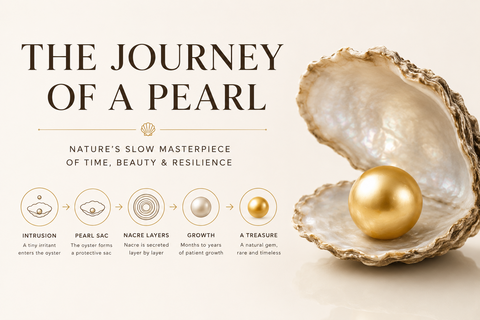
Pearl formation always begins with an unexpected visitor. When a pearl oyster opens its shell to breathe or feed, a small intruder, such as a grain of sand, a fragment of shell, a parasite, or other organic particle may slip inside.
This defensive response is not unique to oysters; many shell-producing creatures in nature, including conch, abalone, and other mollusks, also protect themselves by isolating irritants with layers of nacre.

If this irritant touches or injures the oyster’s mantle tissue (the soft organ responsible for shell and nacre formation), the oyster instinctively activates its defense system. Mantle epithelial cells begin to surround the foreign object, forming a tiny sac. This sac, known as the pearl sac, is the birthplace of a pearl.
It is a natural shield, an attempt by the oyster to isolate what harms it.
Formation of Nacre: The Creation of a Pearl’s Luminous Body
Once the pearl sac forms, the oyster initiates a precise biological process that builds the pearl layer by layer. The mantle epithelial cells begin secreting nacre—the same material that lines the inner shell—composed of three essential elements:
-
Aragonite: microscopic, hexagonal calcium carbonate platelets only a few hundred nanometers thick.
-
Conchiolin: an organic protein that binds the aragonite platelets together.
-
Water: which fills micro-gaps and softens light reflection.
These substances are deposited in ultra-thin nanoscale sheets, each far thinner than a wavelength of light. Subtle variations in thickness and crystal alignment cause the layers to interact with light through optical interference, creating the pearl’s natural iridescence and inner glow.

Over time, thousands of these layers build up into concentric rings. Usually, the thicker the nacre, the richer and deeper the luster is. That is the reason why South Sea and Tahitian pearls, which grow for years, are prized for their exceptional glow. Thick nacre not only enhances beauty but also ensures a pearl’s long-term durability and elegance.
What Determines Pearl Color: The Role of the Mother Oyster
A pearl’s final color depends largely on its host oyster species, especially the pigmentation within its nacre-producing cells.
Examples include:
-
Akoya oysters (Pinctada fucata) Create white, blue, rose, and silver-toned pearls with mirror-like luster.
-
South Sea oysters (Pinctada maxima) Produce gold, champagne, and silver-white pearls thanks to naturally occurring pigments in their mantle.
-
Tahitian black-lip oysters (Pinctada margaritifera) Produce naturally dark pearls in shades of peacock green, eggplant, blue, pistachio, and dark black.
Tahitian pearls exhibit the widest natural color range because their black-lip oysters contain blue, red, and yellow pigments in their mantle tissue, allowing them to produce everything from peacock green to eggplant purple, pistachio (rare), silver-blue (rare), and dark black tones.
Environmental conditions—such as water depth, salinity, mineral content, temperature, plankton levels, and the natural distribution of pigments in the oyster’s mantle—all play a significant role in shaping a pearl’s final color. These subtle differences in habitat explain why pearls from the Philippines may look distinct from those grown in Indonesia.
Growth, Maturation, and the Slow Accumulation of Beauty
Pearl formation is a patient and intricate process. Once the pearl sac is established, the oyster continues to deposit nacre around the existing nacre, one microscopic layer at a time. The length of this growth period varies greatly among species:
-
Akoya pearls: 8–18 months
-
Tahitian pearls: 18–24 months
-
South Sea pearls: 2–5 years
-
Freshwater pearls: 1–3 years
Throughout this time, oysters face constant natural threats—fish, crabs, starfish, and parasites are the primary dangers, capable of damaging the oyster or disturbing its growth cycle, which directly affects pearl quality.
Despite these challenges, the oyster continues laying nacre layer after layer. Over the years, thousands of layers accumulate, gradually shaping the pearl’s body, luster, and durability. Because this process is slow, delicate, and vulnerable to nature, only a small fraction—around 1%—develop the perfect roundness, thick nacre, and high mirror-like luster suitable for fine luxury jewelry. This rarity is what makes high-quality pearls so valuable.

Final Thought: A Treasure Formed by Time, Nature, and Resilience
The formation of a pearl is a quiet miracle of nature, it is a transformation where irritation becomes beauty and disturbance becomes harmony. Layer by layer, year after year, the oyster builds a gem that requires no cutting or polishing. Its perfection is earned through patience and resilience.
Unlike gemstones carved from deep within the earth, pearls are born from life itself. They are shaped not by force, but by heat, crafted through the gentle intelligence of the ocean. In their glow lies a reminder that true beauty often grows slowly, quietly, and with purpose.


