
How Pearls Are Cultivated: From Oyster to Gem
Most pearls sold today are cultured pearls, but that does not make them simple or artificial. A cultured pearl still depends on a living mollusk, skilled implantation, clean water, patient farming, and years of careful selection....
Most pearls sold today are cultured pearls, but that does not make them simple or artificial. A cultured pearl still depends on a living mollusk, skilled implantation, clean water, patient farming, and years of careful selection. Whether the pearl is freshwater or saltwater, the process is a collaboration between human technique and nature.
This guide explains how cultured pearls are made, why freshwater and saltwater cultivation are different, and how the farming process affects the beauty, value, and durability of the finished pearl.
What Is a Cultured Pearl?
A cultured pearl forms when a pearl farmer intentionally introduces mantle tissue, a bead nucleus, or both into a mollusk. The mollusk then creates a pearl sac and deposits nacre layer by layer. Nacre is the luminous material that gives pearls their glow, depth, and surface beauty.

That is why pearl quality is never only about size. GIA’s pearl quality factors include size, shape, color, luster, surface quality, nacre quality, and matching. These factors are directly connected to how the pearl was grown and cared for.
Non-Nucleated Freshwater Pearl Cultivation
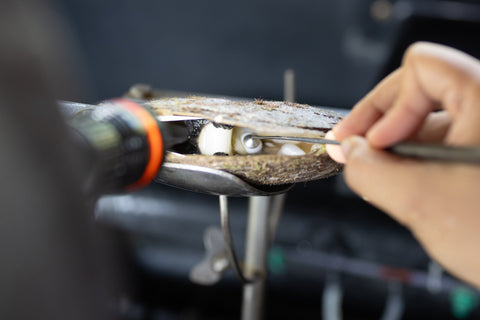
Non-nucleated pearls are most commonly associated with traditional freshwater pearls. Instead of using a round bead nucleus, technicians place tiny pieces of mantle tissue inside the mussel. These tissue pieces contain the cells that can form a pearl sac, where nacre begins to grow.
The process starts with selecting healthy mussels, often around one to two years old. Their strength matters because the health of the mussel influences the pearl’s luster, surface, shape, and final appearance. Technicians then cut small pieces from donor mantle tissue and place them carefully inside the receiving mussel.
After implantation, the mussel is returned to clean, nutrient-rich water. Farmers monitor temperature, oxygen, algae levels, and water quality throughout the growing period. With good care, freshwater pearls may grow for one to three years, depending on the desired size and quality.

Freshwater mussels can often produce several pearls at once, which is why freshwater pearl farming usually has higher output than saltwater pearl farming. The resulting pearls can be round, near-round, oval, button, drop, or baroque. The finest freshwater pearls can show impressive luster and beautiful shape, while baroque freshwater pearls are loved for their organic individuality.
Nucleated Pearl Cultivation
Nucleated pearl cultivation is used for Akoya pearls, South Sea pearls, Tahitian pearls, and some premium freshwater pearls. This method uses a round bead nucleus together with a small piece of mantle tissue.

Before implantation, oysters go through a conditioning period. Farmers select oysters with strong vitality and stable health because the procedure is delicate. A stressed or weak oyster is more likely to reject the nucleus or produce an irregular pearl.
The bead nucleus is usually shaped from shell into a near-perfect sphere. Smaller nuclei are used for Akoya pearls, while South Sea and Tahitian pearls can receive much larger nuclei because their oysters are larger. The technician then places the bead nucleus and mantle tissue inside the oyster with extreme precision.
Placement matters. If the nucleus is not positioned correctly, the oyster may reject it or form a pearl with poor shape. This is one reason why high-quality saltwater pearls are more difficult and costly to produce.
How Long Do Cultured Pearls Take to Grow?
After implantation, oysters and mussels are returned to carefully managed farms. Farmers monitor water temperature, clean the shells, remove barnacles and algae, and protect the mollusks from predators. Depending on the pearl type, farmers may move oysters deeper or shallower in the water to keep them in a stable environment.
Akoya pearls often grow for around 8 to 14 months. South Sea and Tahitian pearls can take much longer, sometimes up to several years. Longer growth can allow thicker nacre, but time alone does not guarantee beauty. Luster, surface quality, shape, and matching still depend on the mollusk, environment, and farming skill.
GIA’s research on the seven pearl value factors is useful here because it explains why a pearl should be judged across multiple qualities, not by one simple label.
Cultivation Methods and Growth Time by Pearl Type
| Pearl Type | Cultivation Method | Typical Growing Period | What This Means for Buyers |
|---|---|---|---|
| Traditional Freshwater Pearls | Usually tissue-nucleated. A small piece of mantle tissue is inserted into a freshwater mussel, and nacre forms around it without a round bead nucleus. | About 1-3 years | Often more affordable, available in many shapes, and can produce beautiful luster. Round pearls are less common than off-round or baroque shapes. |
| Bead-Nucleated Freshwater Pearls | A round bead nucleus and mantle tissue are inserted into a freshwater mussel, similar in concept to saltwater pearl culturing. | Often 1.5-4 years | Can look rounder and more similar to saltwater pearls, but they should still be described as freshwater cultured pearls. |
| Akoya Pearls | Saltwater bead-nucleated pearls grown in Akoya oysters. A shell bead nucleus and mantle tissue are implanted to encourage nacre growth. | Usually about 8-14 months | Known for crisp, mirror-like luster and classic round shapes. Often chosen for traditional pearl studs and strands. |
| Tahitian Pearls | Saltwater bead-nucleated pearls grown in black-lipped oysters, producing naturally dark body colors with green, peacock, aubergine, or silver overtones. | Often about 18-24 months | Best for shoppers who want natural dark color, strong personality, and larger pearl sizes than classic Akoya pearls. |
| South Sea Pearls | Saltwater bead-nucleated pearls grown in Pinctada maxima oysters, including white, champagne, and golden South Sea pearls. | Often about 2-4 years | Usually larger and rarer, with a soft satin-like glow. Longer growth and lower production volume make fine South Sea pearls more expensive. |
Harvesting and Sorting Cultured Pearls
When the pearls are ready, farmers carefully open the mollusks and remove the pearls. Each pearl is washed, sorted, and evaluated. Roundness, luster, surface, color, size, and matching all influence how the pearl will be used.

Some pearls become classic earrings or strands. Others are better suited for pendants, rings, or expressive one-of-a-kind designs. After purchase, proper storage and cleaning also matter. For everyday ownership, De Blancas’ pearl care guide explains how to keep pearl jewelry beautiful over time.
Why Clean Water Matters
The pearl industry is deeply connected to water quality. Oysters and mussels cannot produce beautiful pearls in poor conditions. Clean water, stable ecosystems, and responsible farming are not just ethical concerns; they are part of pearl quality itself.
NOAA notes that oyster aquaculture can provide environmental benefits, including improving water quality and supporting habitat around farm sites. While pearl oysters are not the same as edible oysters, the broader point still matters: healthy bivalves and healthy water systems are closely connected.
For pearl farming, ocean care is not a decorative sustainability claim. It is the foundation of the product.
From Cultivation to Jewelry
The history of cultured pearls is a story of patience, science, and craftsmanship. What begins as a small piece of tissue or a carefully placed nucleus can become a luminous gem after months or years of growth. Every pearl carries evidence of its environment, its farming process, and the hands that selected it.

If you want a pearl piece that reflects this process in a personal way, De Blancas can help you design custom pearl jewelry around your preferred pearl type, size, color, and setting. Explore De Blancas Custom Pearl Jewelry to create a pearl piece shaped around your own style and story.


