

Freshwater Akoya Pearls: What the Term Really Means
A buyer-friendly guide to the phrase freshwater Akoya, why it is a misleading term, and how to compare freshwater and saltwater Akoya pearls with clearer documentation.
Recently, several customers asked us whether De Blancas offers Freshwater Akoya Pearls or Freshwater AK Pearls. Our answer is deliberately clear: De Blancas does not use “Freshwater Akoya Pearl” as a product description, because the phrase is misleading. A pearl can be freshwater, or it can be Akoya. It should not borrow the Akoya name if its origin and growth environment are freshwater.
This does not mean these pearls are fake pearls. Many pearls sold online as “Freshwater AK Pearl,” “Freshwater Akoya,” “Chinese Akoya,” or “Baby Akoya” are real cultured pearls. Some are round, bright, durable, and beautiful. The problem is naming. The more accurate description is usually bead-nucleated freshwater cultured pearl, not Akoya Pearl.

That distinction matters for value, comparison, and trust. If you are looking for classic white Akoya pearl stud earrings, the label should confirm saltwater Akoya identity. If you want an accessible everyday pearl, a well-selected freshwater pearl necklace may be the better choice. Both can be beautiful, but they are not the same category.
What Is a Freshwater AK Pearl?
In current online pearl marketing, Freshwater AK Pearl is often used to describe a newer type of bead-nucleated freshwater cultured pearl, commonly produced in China. Some sellers position it as an “Akoya-class” freshwater pearl because it can be small, round, white, and high-luster. The phrase appears because these pearls can visually resemble saltwater Akoya pearls, especially in photos and livestream lighting.
One supplier-facing description of Freshwater AK Pearl presents it as an Akoya alternative with bead-nucleation, round shapes, strong luster, pastel color options, and thicker nacre than many traditional Akoya pearls. Those claims help explain why the term is attractive commercially: it gives wholesalers and retailers a simple way to describe a pearl that looks closer to Akoya than older tissue-nucleated freshwater pearls.
But from a consumer disclosure perspective, “AK” does not solve the problem. If “AK” is understood as shorthand for Akoya, it can still imply a relationship to Akoya Pearl that the pearl does not actually have. De Blancas would describe the pearl by what it is: bead-nucleated freshwater cultured pearl, with its own merits, limitations, and price expectations.
Why “Freshwater Akoya Pearl” Is Misleading
The Gemological Institute of America has addressed this terminology issue directly. In its article “Freshwater Akoyas - A Trending Misnomer for Certain Freshwater Pearls”, GIA explains that true Akoya cultured pearls are saltwater pearls from the Pinctada fucata mollusk, while pearls marketed as “Freshwater Akoya,” “Chinese Akoya,” or “Baby Akoya” are freshwater pearls, often associated with freshwater mussels such as Hyriopsis cumingii or other variants.
In plain language: Freshwater Akoya Pearl is not a proper pearl category. The phrase mixes a growth environment, freshwater, with a saltwater pearl type, Akoya. A pearl's identity is not decided by how similar it looks in a photo. It is determined by origin, mollusk, environment, culturing method, and, for higher-value purchases, independent documentation.
This is why De Blancas avoids terms that may create category confusion. We can appreciate a beautiful freshwater pearl without calling it Akoya. Transparent language protects the customer and keeps each pearl type in its proper place.
Freshwater AK Pearl vs Akoya Pearl vs Freshwater Pearl
| Feature | Freshwater AK Pearl | Akoya Pearl | Freshwater Pearl |
|---|---|---|---|
| Proper category? | Marketing term, not a formal pearl category | Recognized saltwater cultured pearl type | Recognized freshwater cultured pearl category |
| Environment | Freshwater | Saltwater | Freshwater |
| Typical mollusk | Freshwater mussel | Pinctada fucata | Freshwater mussel |
| Nucleation | Usually bead-nucleated | Usually bead-nucleated | Can be tissue-nucleated or bead-nucleated |
| Look | Often round, bright, and Akoya-like | Known for crisp, mirror-like luster and classic white-to-cream tones | Wide range of shapes, sizes, colors, and luster levels |
| Common colors | White, pink, lavender, and other freshwater tones | White to cream, often with rose, silver, or cream overtones | White, peach, pink, lavender, and more |
| Price expectation | Should be compared with premium freshwater pearls | Often priced higher because of saltwater cultivation costs and market recognition | Usually more accessible, with wide quality range |
| Best wording | Bead-nucleated freshwater cultured pearl | Akoya cultured pearl | Freshwater cultured pearl |
| De Blancas usage | We would not use this as a product name | Used only when the pearl is genuinely Akoya | Used when the pearl is genuinely freshwater |
| Related De Blancas example | White Freshwater Pearl Stud Earrings(AAA variant) | White Akoya Pearl Stud Earrings |
Why Freshwater AK Pearls Can Look Like Akoya Pearls
The visual similarity comes from modern culturing technique. Traditional freshwater pearls were often tissue-nucleated, which meant they could form without a round bead nucleus. Many were beautiful, but the shapes were more varied, and shoppers often associated freshwater pearls with softer luster or more organic forms.

Bead-nucleated freshwater pearls changed that expectation. When a round shell bead is inserted into a freshwater mussel, nacre forms around a more uniform foundation. The finished pearl can be rounder and brighter, with a sharper reflection than many older freshwater pearls. Under retail lighting, it may resemble an Akoya Pearl at first glance.
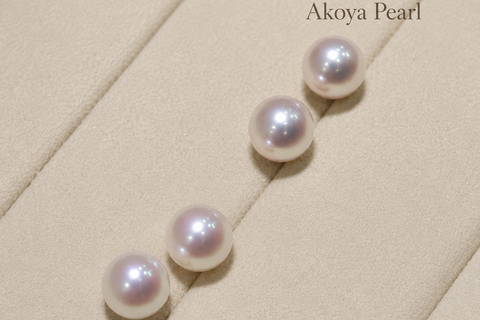
This is why the comparison exists. It is reasonable to say that some bead-nucleated freshwater pearls have an Akoya-like look. It is not accurate to call them Akoya Pearls. Similar appearance does not create the same origin, the same gemological identity, or the same market value.
Are Freshwater AK Pearls Lower Quality?
No. This is where the conversation needs nuance. A misleading name does not automatically mean the pearl itself is poor. Some bead-nucleated freshwater pearls are excellent. They may offer strong luster, pleasing roundness, natural pink or lavender tones, and good everyday durability. For many jewelry designs, they can be a smart and beautiful choice.
The issue is not freshwater versus Akoya as a simple quality ranking. The issue is whether the buyer is being given the correct benchmark. If a seller prices a freshwater pearl against freshwater standards and discloses it clearly, the customer can make a fair decision. If the seller uses the Akoya name to make a freshwater pearl feel more prestigious, the buyer may overpay or misunderstand what they are purchasing.
At De Blancas, we prefer category clarity over misleading naming. A freshwater pearl should be celebrated as freshwater. An Akoya Pearl should be described as Akoya only when it is truly Akoya.
How to Check Before You Buy
Start with the product title and specification. If you see “Freshwater Akoya Pearl,” “Freshwater AK Pearl,” “Chinese Akoya,” or “Baby Akoya,” ask the seller whether the pearl is freshwater or saltwater. If the answer is freshwater, then it should be compared with freshwater pearls, not saltwater Akoya Pearls.
Next, look for documentation. GIA's sample pearl report information shows that pearl reports can document details such as quantity, shape, color, identity, mollusk when determinable, environment, and detectable treatments. For higher-value pearl purchases, the environment line, freshwater or saltwater, is especially important.
Finally, compare price with the correct category. A freshwater pearl that looks like Akoya can still be a good purchase, but it should not be priced or presented as genuine Akoya unless the documentation supports that identity. When a price looks surprisingly low for Akoya, there may be a reason: the pearl may be freshwater, lower grade, treated, or simply described imprecisely.
Our Position at De Blancas
De Blancas will not label freshwater pearls as “Freshwater Akoya Pearls.” We also avoid using “Freshwater AK Pearl” as a customer-facing pearl category. If a pearl is freshwater, we will call it freshwater. We used the grading difference to separate freshwater pearls' tiers. If it is Akoya, we will call it Akoya, which is simple.
This approach is not anti-freshwater. We love freshwater pearls when they are selected and described honestly. They can be versatile, expressive, and excellent value. But value becomes meaningful only when the customer understands what they are buying.
If your goal is the classic Akoya look, consider clearly identified Akoya pieces such as our white Akoya pearl stud earrings or an Akoya pearl pendant. If your goal is size, daily wear, or accessible pricing, a freshwater pearl design may be the better direction. The right choice begins with the right name.
FAQ: Freshwater AK Pearl and Freshwater Akoya Pearl
Is Freshwater AK Pearl the same as Akoya Pearl?
No. Freshwater AK Pearl is generally a marketing term for bead-nucleated freshwater cultured pearl. Akoya Pearl is a saltwater cultured pearl category.
Is Freshwater Akoya Pearl a real pearl?
The pearl may be a real cultured pearl, but “Freshwater Akoya Pearl” is not accurate category language. If it is freshwater, it should be identified as freshwater cultured pearl.
Why do sellers use the term Freshwater AK Pearl?
They use it because some modern bead-nucleated freshwater pearls can be round, bright, and visually similar to Akoya Pearls. The term is commercially convenient, but it can confuse buyers.
Are Freshwater AK Pearls worth buying?
They can be worth buying when they are priced and disclosed as premium freshwater pearls. They should not be valued as genuine Akoya Pearls unless documentation confirms saltwater Akoya identity.
What should I ask before buying?
Ask whether the pearl is freshwater or saltwater, whether it is bead-nucleated, whether treatments are disclosed, and whether an independent pearl report is available for higher-value jewelry.
Final Takeaway
Freshwater AK Pearl may describe a real and attractive bead-nucleated freshwater pearl, but Freshwater Akoya Pearl is misleading. Akoya is not a visual style alone; it is a saltwater pearl identity. At De Blancas, we believe pearl names should help customers understand value, not blur it. Choose pearls by verified identity, transparent disclosure, and the beauty that genuinely fits your life.


