

Real Pearls vs Fake Pearls: How To Tell Difference?
Wondering how to tell if pearls are real? This expert guide explains seven practical tests used by pearl graders, from touch and weight to luster, drill holes, nacre structure, and signs of high-end imitation pearls. Learn...
If you're shopping for pearls and want to be certain you're buying the real thing, home tests like the tooth test or the cold touch test can only take you so far. At De Blancas, where we grade thousands of cultured pearls each year, our specialists rely on a set of physical clues that are rarely mentioned in mainstream guides. How to tell if pearls are real is about more than one quick trick; it's about understanding what genuine nacre looks, feels, and wears like over time. Here are seven grader-level tests to help you separate real pearls from imitation ones with greater confidence.
Use Touch to Separate Real Pearls from Imitations
Real pearls behave differently than glass, ceramic, or plastic when you handle them. The combination of weight, temperature, and surface resistance gives away what a quick glance misses.
Do real pearls feel cold when you first touch them?
Yes, initially. Genuine cultured pearls are mineral-based and conduct heat from your skin quickly, creating a brief cool sensation. The difference is that a real pearl warms to body temperature in just a few seconds. An imitation made of glass or ceramic stays cold much longer. I’ve timed this during grading sessions: a glass bead still feels cool after a full minute in your palm, whereas a real pearl reaches skin warmth almost immediately.
What weight difference should you notice?
Real pearls have a noticeable density. A strand of cultured pearls will feel heavier than it looks. Plastic or hollow glass fakes feel light and airy. When you pick up an unfamiliar piece, let the weight register in your hand. Genuine nacre never feels hollow.
Does the tooth test actually work?
It does, but only when applied correctly. Rub the pearl gently against a front tooth. Real nacre has a gritty, almost sandpaper-like texture because it consists of microscopic overlapping aragonite platelets. Imitation pearls feel smooth or slippery. This test is reliable for most cheap fakes, though a few high-end ceramic imitations can produce a faint texture. That’s why we always pair the tooth test with a loupe check.
Evaluate Luster and Surface for Real Pearl Characteristics
The way a pearl reflects light is the hardest feature for an imitation to copy. Place a pearl under a single light source and watch how the shine behaves.
| Characteristic | Real Pearl | Imitation Pearl |
|---|---|---|
| Luster depth | Deep, soft glow that seems to come from within; sharp reflection with a halo-like orient | Glassy, flat shine that sits only on the surface; no sense of depth |
| Surface texture | Slight irregularities, tiny dimples, concentric growth rings; no two pearls look identical | Overly smooth, often with repeating patterns or unnatural perfection |
| Nacre layering | Layered translucent nacre that creates a subtle, shifting iridescence | Uniform material; any iridescence is applied as a uniform coating |
What enables a real pearl’s layered brilliance?
Cultured pearls grow when a mollusk deposits successive layers of nacre around a nucleus, creating an interference effect where light bounces between those microscopic layers. This produces what pearl graders call "orient": a soft, rainbow-like glow that moves as you rotate the pearl. Fake pearls rely on painted or dipped coatings, and their shine stays fixed regardless of the angle.

Can imitation pearls produce an iridescent sheen?
Yes, some can. Lower-grade synthetics use cheap pearlescent paints, while better ones have multi-layer coatings that mimic iridescence. The giveaway is consistency. On a real pearl, the iridescence shifts slightly from one area to another; on a fake, the same rainbow band appears evenly across every bead in a strand.
Study the Drill Hole to Confirm Pearl Authenticity
Whenever we receive a strand for evaluation, the first thing we check under a loupe is the drill hole. No other area provides a clearer view of what lies beneath the surface.
What does a real pearl’s drill hole reveal?
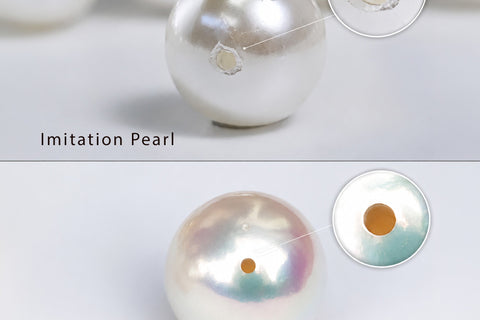
Under magnification, you will see a clear boundary between the surface and the nacre layers below. In an imitation, the hole reveals a single uniform material, such as glass, plastic, or a chalky composite, with no layered structure.

Why is the coating near the drill hole important?
Imitation pearls often chip around the hole, exposing a dull base color or a white plastic core underneath a thin painted finish. Real pearls may show a slight roughness at the hole edge, but the color remains consistent because nacre goes all the way through. Our graders also look for flaking or peeling, which only happens with surface-applied coatings.
If you are examining a piece and the drill hole looks suspiciously uniform or lacks any concentric layers, you likely have a fake. To be certain, send a clear close-up image of the hole to our pearl specialists. We can often confirm authenticity within minutes.
Detect High-End Fakes That Mimic Genuine Pearl Structure
Some imitations now use real pearl powder or multi-layer coatings that fool the tooth test and even the eye. Knowing what specifically to look for under magnification keeps you a step ahead.
| Imitation Type | How It Fakes Pearl Properties | What a Loupe Reveals |
|---|---|---|
| High-density ceramic | Mimics weight and cool feel; sometimes has faint texture | No layered nacre structure; uniform, granular surface |
| Shell-based composite | Uses ground shell mixed with binder; copies luster and weight | Surface craters or slightly orange-peel texture; lacks natural growth marks |
| Glass with multi-coating | Coating creates iridescence; some have dipped layers | Coating edge visible at drill hole; reflection is glassy, not deep |
How well do high-end fakes replicate pearl characteristics?
The best imitations now replicate weight, surface feel, and even a subtle iridescence well enough to win a passing glance from a casual shopper. Where they fail is in the natural randomness of organic structure. Under 10x magnification, a real pearl will never be perfectly uniform; you will always find minor waviness, a growth circle, or a tiny irregularity that speaks to its biological origin. High-grade fakes are machine-made, and that consistency becomes their undoing under close inspection.

Shop Real Pearls with Confidence: Get Expert Guidance
Uncertainty around authenticity should not keep you from enjoying the elegance of genuine cultured pearls. At De Blancas, we have spent over a decade farming, grading, and selecting pearls directly from Philippine and Indonesian waters, so we know exactly what separates a real pearl from a skilled imitation.
If you have a piece you would like verified, or you are ready to choose a new pearl with certainty, contact our specialists. Send a photo of the piece and your requirements to [email protected]. We will evaluate what you have and guide you toward an authentic, farm-sourced selection that matches your expectations.
Common Questions About Telling Real Pearls from Fakes
Is it safe to use a flame to test a pearl?
No, and we strongly advise against it. Real nacre is organic and can burn or discolor when exposed to flame, permanently damaging the pearl. Some sources claim that real pearls won't burn. That is misleading. A brief flame can char the surface of even the finest cultured pearl, so this test ruins the piece you are trying to evaluate.
I bought a strand labeled “cultured” online, but something feels off. What should I do?
We have assisted many customers in this exact situation. First, run the basic touch and visual tests outlined here. If you still have doubts, send us a few close-up photos, especially of the drill hole and a direct light reflection shot. Our pearl specialists will tell you whether the characteristics match those of farmed cultured pearls or point to an imitation.


