

Jewelry Making Tools: 6 Essential Pliers and Cutters for Beginners
Learn what six essential jewelry making pliers and cutters do, when to use each one, and which three tools beginners should buy first.
Jewelry making becomes much easier when each tool has a clear job. Although many pliers look similar at first, the shape of their jaws determines whether they are best for gripping, bending, looping, reaching into tight spaces, or cutting wire.
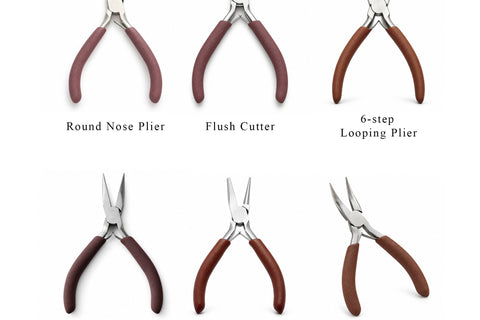
This first part of our jewelry making tools guide focuses on five shaping and gripping pliers, plus one essential cutter. Together, they cover many of the tasks used in wirework, beading, and jewelry assembly.
The essential starter set
- Choose chain-nose pliers for gripping and general assembly.
- Use round-nose pliers to make loops and smooth curves.
- Keep flush cutters nearby for clean, controlled trimming.
- Add specialized pliers when you need better access or repeatable sizes.
Six Essential Jewelry Making Pliers and Cutters
You do not need every specialized tool before beginning your first project. A pair of chain-nose pliers, a pair of round-nose pliers, and a flush cutter make a practical starter set. The other tools become especially useful when you want more consistent loops, a different jaw profile, or easier access to small components.
1. Chain-Nose Pliers: The Everyday Gripping Tool

The tapered jaws combine a precise tip with a broader gripping surface.
Chain-nose pliers have tapered jaws that are broad near the hinge and narrow toward the tip. This shape gives you a secure grip while still allowing you to work with small findings and detailed areas.
Use chain-nose pliers to:
- Open and close jump rings
- Grip small jewelry components
- Hold wire while bending or positioning it
- Make precise adjustments during assembly
For opening a jump ring, grip each side of the opening and twist the ends sideways, moving one toward you and the other away from you. This helps the ring keep its round shape better than pulling the ends directly apart.
Best for: Everyday assembly, jump rings, findings, and precise wire handling.
2. Round-Nose Pliers: The Classic Loop-Making Tool

Smooth, cone-shaped jaws let you choose the diameter of a loop.
Round-nose pliers have two smooth, cone-shaped jaws. They are designed for curving wire rather than flattening it, making them one of the most important tools for creating loops and rounded forms.
Use round-nose pliers to:
- Form simple loops and wrapped loops
- Bend wire into smooth curves
- Shape eye pins and headpins
- Create rounded jewelry components
The position of the wire on the jaw affects the size of the loop. Work closer to the narrow tip for a smaller loop or farther down the jaw for a larger one. If you want several loops to match, mark your preferred position on the jaw with a removable marker.
Best for: Earrings, dangles, charms, wire links, and any project that needs a neat circular loop.
Maker's tip
Use only as much pressure as the task requires. A controlled grip helps protect soft wire and delicate findings from unwanted marks.
3. Round-and-Flat-Nose Pliers: Two Jaw Shapes in One Tool

One rounded jaw shapes the curve while the flat jaw supports the wire.
Round-and-flat-nose pliers combine one rounded jaw with one flat jaw. The round side helps shape curves and loops, while the flat side supports and grips the wire. This combination offers more control when a standard pair of round-nose pliers feels too symmetrical for the task.
Use round-and-flat-nose pliers to:
- Bend and shape wire
- Form loops with added support
- Hold delicate components while adjusting them
- Create curved forms with a flatter inner surface
Because the two jaws make different impressions, check which side is touching the visible face of the wire before applying pressure. A light grip is usually enough when working with delicate components.
Best for: Controlled wire shaping, supported loops, and detail work that benefits from both a round and a flat surface.
4. Bent-Nose Pliers: Better Access in Tight Spaces

Angled jaws approach crowded components from the side and keep the work visible.
Bent-nose pliers have angled jaws that let your hand approach the work from the side. The bend can improve visibility and help you reach areas that are awkward with straight pliers, especially when several wires or components sit close together.
Use bent-nose pliers to:
- Grip and position wire in hard-to-reach areas
- Adjust small components without blocking your view
- Bend wire around nearby findings
- Support detailed or layered wirework
They are especially convenient as a second gripping tool. For example, you can hold one side of a component with chain-nose pliers while using bent-nose pliers to make the adjustment from another angle.
Best for: Tight spaces, complex assemblies, layered wirework, and tasks where straight jaws obstruct your view.
5. Six-Step Looping Pliers: Consistent Sizes Made Simple

Six stepped barrel sizes make repeated components easier to match.
Six-step looping pliers feature stepped cylindrical jaws in six sizes. Instead of estimating the position on a tapered jaw, you can wrap wire around a specific step to repeat the same diameter from one component to the next.
Use six-step looping pliers to:
- Form consistent loops in different sizes
- Make matching jump rings
- Shape wire coils
- Create repeated wire-wrapped components
Choose one step for your project and use that same section for every matching component. This is particularly helpful when producing pairs of earrings or a series of links that should look uniform.
Best for: Repetition, size consistency, matching components, jump rings, and coils.
6. Flush Cutters: Clean, Controlled Wire Cutting

Flush cutters trim wire and headpins close to the finished component.
Flush cutters are not shaping pliers, but they belong in the same essential toolkit. Their cutting jaws are designed to trim wire, headpins, and similar jewelry-making components with a cleaner edge than general-purpose cutters.
Use flush cutters to:
- Trim jewelry wire to length
- Cut excess wire from wrapped loops
- Shorten headpins before forming a loop
- Remove unwanted wire ends during assembly
For the cleanest finish, place the flatter side of the cutter toward the part you want to keep. The opposite side of the cut may be more angled, so always inspect the wire end before it sits against skin or another component. Wear eye protection and direct the cut end away from yourself, as short pieces of wire can spring away.
Best for: Neat wire ends, headpins, finishing work, and precise trimming.
Which Jewelry Making Pliers Should a Beginner Buy First?
If you are building a beginner jewelry tool kit, start with these three:
- Chain-nose pliers for gripping, opening jump rings, and general assembly
- Round-nose pliers for loops, curves, and wire shaping
- Flush cutters for clean, controlled cutting
This trio can handle many beginner earrings, pendants, bracelets, and simple wirework projects. Add bent-nose pliers when you need better access, round-and-flat-nose pliers when you want a mixed jaw profile, and six-step looping pliers when consistent sizing becomes a priority.
The best starter tool kit is not the largest one. It is the set that gives you a reliable grip, a smooth loop, and a clean cut.
How to Choose and Care for Jewelry Making Pliers
Look for jaws that meet evenly, comfortable handles, and a spring action that opens smoothly. Smooth jaw surfaces are useful for many delicate jewelry tasks because pronounced teeth can leave marks on soft wire and findings. The right tool should feel controlled in your hand rather than oversized or difficult to close.
Keep the jaws clean so dirt or metal fragments do not mark your work. Avoid squeezing harder than necessary, use each tool only with materials it is designed to handle, and store cutters where their edges will not be knocked against other steel tools. Before completing a piece, inspect loops and cut ends by sight and touch.
The right pliers do more than make jewelry making faster. They give you cleaner bends, more consistent loops, and better control over small components. Once you understand what each jaw shape is designed to do, choosing the correct tool becomes a natural part of the making process.
FAQ
What are the three most important jewelry making tools for beginners?
Start with chain-nose pliers, round-nose pliers, and flush cutters. Together, they cover gripping, jump-ring work, basic loops, wire shaping, and trimming.
Can regular household pliers be used for jewelry making?
They may work for rough tasks, but their size or textured jaws can make delicate work harder and may mark softer wire. Jewelry pliers offer finer tips and shapes designed for small components.
What is the difference between round-nose and looping pliers?
Round-nose pliers have tapered jaws, so loop size changes depending on where the wire sits. Six-step looping pliers provide fixed barrel sizes, making repeated loops easier to match.
Why do I need two pliers to open a jump ring?
Two tools give you control over both sides of the opening. Twist the ends sideways instead of pulling them apart so the ring is easier to return to its original round shape.
Start Your Next Pearl Jewelry Project
Good tools turn small ideas into precise, wearable details. If you would rather begin with a concept and work with an expert on the final piece, explore the De Blancas Custom Pearl Jewelry Designer.


